
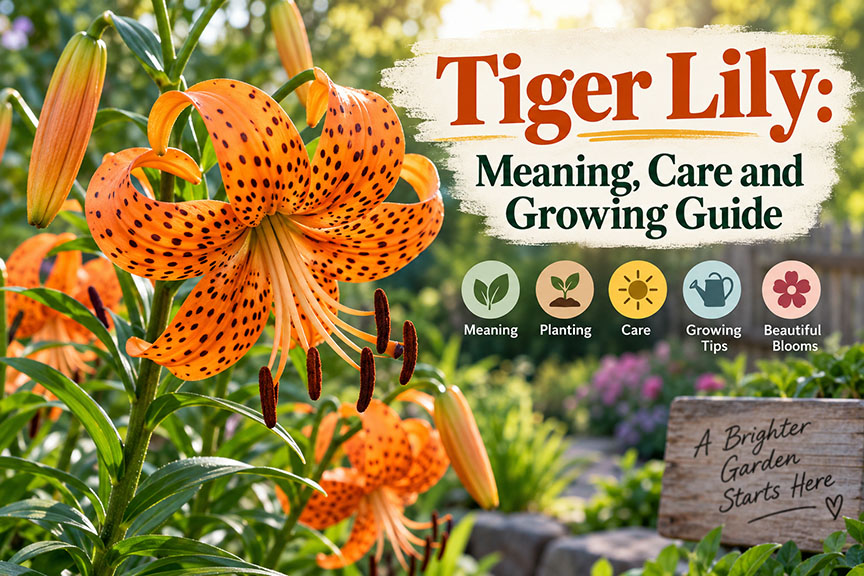
Bright orange flowers, dark spots, and dramatically curved petals make the Tiger Lily one of the easiest lilies to recognize in a summer garden. This hardy perennial adds height and strong color to borders while requiring relatively straightforward care once established. For gardeners considering this distinctive flower, understanding its growing conditions, watering needs, propagation, and potential problems can make a noticeable difference in plant health.
What Is a Tiger Lily?
The plant commonly known as the Tiger Lily is Lilium lancifolium, a bulb-forming herbaceous perennial in the Liliaceae family. It was formerly known as Lilium tigrinum, a botanical name that still appears in older gardening references.
The species is native to parts of eastern Asia, including China, Japan, Korea, Tibet, and far eastern Russia. It has also naturalized in other regions, including parts of eastern North America.
A mature plant typically develops an upright, largely unbranched stem lined with narrow, lance-shaped leaves. The flowers are usually orange with prominent dark spots. Their petals curve backward, giving each bloom its characteristic appearance.
Another useful identification feature is the small, dark bulbils that form in the leaf axils along the stem. These structures can eventually fall to the ground and produce new plants.
Tiger Lily Meaning and Symbolism
Flowers often acquire different meanings across cultures and periods, so there is no single universal interpretation. Still, the bold orange coloring and spotted appearance of these lilies have commonly inspired associations with confidence, energy, prosperity, and pride.
In a garden, their practical appeal is easier to define. The tall stems and vivid blooms create a strong focal point and work particularly well toward the middle or back of a perennial border.
Gardeners should also remember that common plant names can be confusing. Several unrelated or different Lilium species may sometimes be called a “tiger lily.” Checking the botanical name is the safest way to know exactly what you are planting.
How to Grow Tiger Lily Successfully
This species has a reputation for being relatively easy to establish when its basic requirements are met. Good sunlight and drainage are especially important.
Choose the Right Location
Tiger Lily performs best in full sun, although it can tolerate partial shade. Plants growing with insufficient light may survive but generally produce fewer flowers.
Choose a location where taller stems will not excessively shade smaller plants. Depending on growing conditions, established plants can become several feet tall, so placing them behind low-growing perennials often creates a balanced garden design.
Prepare Well-Drained Soil
Good drainage is one of the most important requirements for lilies. Constantly waterlogged ground can encourage bulb rot and other problems.
Soil enriched with organic matter can help provide a productive growing environment while maintaining moisture. Heavy soil may need improvement before planting so that excess water can move away from the bulbs.
The goal is moist but well-drained ground rather than permanently wet soil.
Plant at a Suitable Depth
Lily bulbs are commonly planted in fall, although locally available bulbs may sometimes be planted at other appropriate times.
A general guideline for hardy lilies is to plant bulbs around 6 to 8 inches deep, with enough space between plants for air movement and future growth. Local soil conditions and bulb size can influence the ideal depth, so instructions supplied with purchased bulbs are worth following.
Water after planting to settle the surrounding soil.
Tiger Lily Care Through the Growing Season
Once established, Tiger Lily care is fairly manageable. Consistency matters more than complicated maintenance.
Watering
Keep the soil reasonably moist during active growth, particularly during prolonged dry weather. Avoid frequent shallow watering that only wets the surface.
At the same time, do not allow bulbs to sit in saturated ground. Poor drainage increases the likelihood of bulb rot.
A layer of organic mulch can help conserve moisture and moderate soil temperature. Keep excessively heavy mulch from accumulating directly against plant stems.
Feeding
Plants growing in reasonably fertile soil may not require heavy feeding. Adding compost or another source of organic matter can support soil structure and nutrient availability.
If fertilizer is needed, use an appropriate garden fertilizer according to its label rather than assuming that more fertilizer will produce more flowers. Excessive feeding can encourage unwanted leafy growth.
Supporting Tall Stems
Plants in exposed locations can sometimes lean or bend during wind and heavy rain. If stems become unstable, use discreet stakes and soft plant ties.
Installing support before the plant becomes top-heavy is easier than trying to straighten a damaged stem later.
When Does Tiger Lily Bloom?
Flowering generally occurs in summer. Exact timing varies according to climate, local weather, and growing conditions.
Multiple flowers may appear toward the upper part of each mature stem. Their downward-facing orange blooms and strongly recurved petals make them especially noticeable among softer-colored garden plants.
After flowering, allow healthy foliage to remain until it naturally yellows and declines. The leaves continue supporting the bulb after the flowers have faded, so removing green foliage too early can interfere with the plant’s normal growth cycle.
How to Propagate Tiger Lily
One interesting characteristic of Lilium lancifolium is its production of bulbils. These small structures develop where leaves meet the stem and provide gardeners with a convenient propagation method.
Mature bulbils can be collected and planted in suitable soil. They need time to develop into flowering-size bulbs, so this is not an instant way to produce mature plants.
The species can spread readily through fallen bulbils. This can be useful if you want a larger display, but gardeners working in tightly controlled borders may need to remove unwanted young plants.
Established lilies can also be propagated by separating bulbs when clumps become crowded. Division gives the remaining bulbs additional growing space and provides plants for another part of the garden.
Common Pests and Diseases
Although generally robust, Tiger Lily plants are not immune to problems.
Aphids may feed on lilies and can also transmit viral diseases. Botrytis can affect foliage, particularly where conditions encourage prolonged moisture around leaves. Bulb rot is another concern when soil remains excessively wet.
Good gardening practices reduce many problems. Give plants reasonable spacing, avoid chronically waterlogged soil, inspect leaves regularly, and remove unhealthy plant material when necessary.
If a lily develops unusual streaking, mottling, distortion, or persistent poor growth, consider whether disease rather than nutrition or watering could be responsible.
An Important Warning for Cat Owners
Tiger Lily requires special consideration in homes and gardens with cats. True lilies in the Lilium genus can cause severe kidney injury in cats, and even relatively small exposures can be dangerous.
Leaves, flowers, pollen, and other plant material can present a risk. Cats may also be exposed when grooming pollen from their fur.
For households with cats, the safest approach is to prevent access to these lilies altogether. If you suspect that a cat has contacted or ingested lily material, contact a veterinarian or animal poison-control service immediately rather than waiting for symptoms to develop.
Frequently Asked Questions
Does Tiger Lily come back every year?
Yes. It is a bulb-forming herbaceous perennial. Its above-ground growth dies back seasonally, while the bulb remains underground and can produce new shoots during the next growing cycle when conditions are suitable.
Does Tiger Lily need full sun?
Full sun generally produces the strongest flowering, but the plant can tolerate some partial shade. Too much shade may reduce the number of blooms.
Can Tiger Lily grow in containers?
Lilies can be grown in sufficiently large containers if drainage, moisture, sunlight, and root space are managed properly. Choose a pot with drainage holes and avoid leaving the growing medium continuously saturated.
How tall does Tiger Lily grow?
Growing conditions influence mature size, but Lilium lancifolium can reach several feet in height. North Carolina State Extension lists a potential height range of roughly 2 to 6 feet.
How does Tiger Lily spread?
It readily reproduces through bulbils produced along the stem. These can drop onto the soil and eventually develop into additional plants. Bulbs can also multiply underground.
Should I remove flowers after they fade?
Spent blooms can be removed for appearance, but healthy green stems and leaves should generally remain until they naturally yellow. This allows the plant to continue supporting its underground bulb.
Conclusion
Tiger Lily combines distinctive summer flowers with relatively simple care requirements, making it a useful choice for sunny perennial gardens. Provide good drainage, adequate sunlight, consistent moisture, and enough room for mature stems to develop. Watch for unwanted spreading from bulbils and common lily problems such as aphids and rot.
With thoughtful placement and routine maintenance, this striking perennial can return year after year and provide strong color and vertical interest when many summer borders are at their peak.
Read Also: Tiger Lily Flower: Meaning, Care and Growing Guide