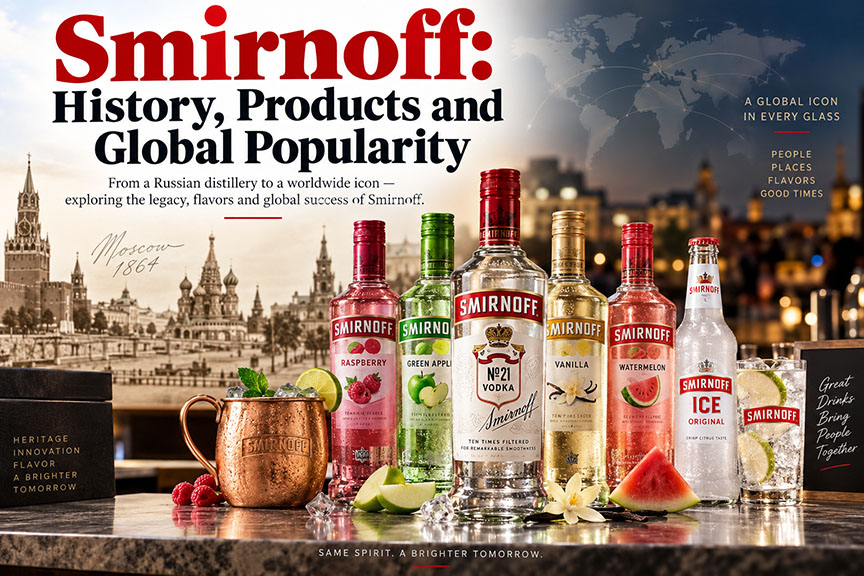
Few vodka names have traveled as far or become as recognizable as Smirnoff. What began as a Russian distilling business in the 19th century eventually developed into an international drinks brand with classic vodka, flavored spirits, and ready-to-drink beverages. Its long history, straightforward production style, wide product range, and presence in markets around the world have helped keep the name familiar to generations of adult consumers.
The History of Smirnoff
The brand traces its modern history to 1864, when Pyotr Arsenievich Smirnov established a vodka distillery in Moscow. One feature associated with his production was charcoal filtration, a method used to refine the spirit and create a cleaner finished character.
The business became successful in Russia, but political upheaval dramatically changed its future. Following the Russian Revolution, the Smirnov family lost control of its operations in Russia. Pyotr’s son Vladimir later left the country and re-established the family vodka business in Europe during the early 1920s.
Outside Russia, the family name was presented in its Anglicized form: Smirnoff. That spelling eventually became the identity recognized by consumers internationally.
The brand’s move beyond its Russian origins was important. Vodka did not historically have the same established position in many Western markets as spirits such as whisky or gin. Expansion into Europe and later North America therefore required more than simply introducing another label; consumers also had to become more familiar with vodka as a versatile spirits category.
Today, the brand is owned by Diageo, the international beverage company whose portfolio includes numerous spirits and beer brands.
How Smirnoff Vodka Is Produced
Production methods are an important part of the brand’s identity. Its flagship No. 21 vodka is distilled three times and filtered ten times.
Distillation separates and concentrates alcohol while helping producers control the character of the finished spirit. Filtration further refines it. These processes contribute to the relatively clean and neutral profile expected from mainstream vodka.
The raw material can vary by market and production location. For example, the company’s U.S. information states that its vodka sold there is made from corn. Consumers should therefore check the label or official information for their own market rather than assuming that every bottle sold globally has identical specifications.
Alcohol strength can also differ depending on the country and expression. No. 21 is sold at 37.5% alcohol by volume (ABV) in some markets, while U.S. versions are commonly available at 40% ABV, or 80 proof.
Popular Smirnoff Products
One reason for the brand’s broad reach is that it does not depend on a single bottle. Its portfolio covers traditional vodka, higher-proof expressions, flavored varieties, and convenient ready-to-drink options. Exact availability differs between countries.
Smirnoff No. 21
No. 21 is the flagship expression and the product most closely associated with the familiar red label. Its relatively neutral profile makes it suitable for a range of mixed drinks rather than limiting it to one serving style.
The vodka can be used in familiar cocktails such as a Moscow Mule, Cosmopolitan, Bloody Mary, or vodka-based Martini. That versatility has helped No. 21 remain the foundation of the wider product family.
Higher-Proof Vodka
Certain markets also offer stronger expressions. In the United States, for example, No. 57 is listed at 50% ABV. Higher-proof vodka has a more noticeable alcohol presence and may be chosen for cocktails where the spirit needs to remain prominent alongside strongly flavored mixers.
It is worth checking ABV carefully before serving any unfamiliar expression because bottles within the same brand family do not necessarily have the same alcohol content.
Flavored Vodkas
Flavored spirits have allowed Smirnoff to move beyond traditional neutral vodka. Depending on the market, consumers may encounter fruit, citrus, vanilla, berry, or more unusual flavor combinations.
The U.S. range has included varieties such as Raspberry, Green Apple, Watermelon, Peach, Pineapple, Vanilla, Lime, and Spicy Tamarind, alongside several lemonade-inspired and zero-sugar infusion products.
These expressions are designed to provide an existing flavor base for mixed drinks. They can simplify cocktails because a bartender or home mixer can introduce fruit or other flavor notes without relying entirely on additional syrups or liqueurs.
What Is Smirnoff Ice?
Smirnoff Ice is part of the company’s ready-to-drink portfolio rather than simply being another bottle of standard vodka.
The range is intended to be served chilled and offers a convenient alternative to preparing a mixed drink from separate ingredients. The Original version is known for its crisp lemon flavor, while additional varieties differ between international markets.
Alcohol content and formulation should always be checked locally. Product names that look similar can have different formulations or strengths depending on where they are sold.
The ready-to-drink category has become a significant part of the brand’s international presence. According to its parent company, Smirnoff Ice has been on the market for more than 25 years and is available across more than 140 countries.
Why Smirnoff Became Globally Popular
Global recognition rarely comes from one factor. In this case, history, distribution, product variety, and vodka’s flexibility as a cocktail ingredient have all played a role.
Diageo reports that the core vodka brand is sold in more than 130 countries. This large distribution network makes it accessible to consumers in many different beverage markets.
Another advantage is versatility. Neutral vodka can work with citrus, ginger beer, tomato juice, fruit flavors, soda, and many other ingredients. A single bottle can therefore fit numerous cocktail styles.
Product expansion has also helped the company appeal to different preferences. Someone interested in traditional vodka may choose No. 21, while another consumer may prefer a flavored expression or a ready-to-drink option.
Brand recognition reinforces that reach. The red label and long-established bottle identity are easy to identify on a crowded retail shelf or behind a bar.
Smirnoff and Cocktail Culture
Vodka’s relatively neutral character makes it particularly adaptable in cocktails because it can add alcohol without dominating every other ingredient.
The Moscow Mule is closely connected with the brand’s American history. The cocktail combines vodka with ginger beer and lime and became an important way of introducing American drinkers to vodka during the 20th century.
Other familiar choices include the Bloody Mary, Cosmopolitan, Screwdriver, and vodka Martini. Modern flavored products offer even more combinations, although a balanced drink still depends on matching sweetness, acidity, dilution, and alcohol strength.
For anyone preparing cocktails, measuring servings is more reliable than free-pouring. It improves consistency and makes it easier to keep track of the amount of alcohol being served.
What Consumers Should Know Before Choosing a Bottle
Not every Smirnoff product is interchangeable. A standard unflavored vodka, a flavored spirit, a higher-proof bottle, and a ready-to-drink beverage can differ substantially in taste, strength, ingredients, sugar, and intended use.
Check the product label for:
- Alcohol by volume (ABV)
- Bottle or serving size
- Flavor and product type
- Ingredient or allergen information where provided
- Country-specific product details
This is especially useful when comparing products from different markets. Recipes, alcohol levels, and available flavors can change from one country to another.
As with any alcoholic beverage, consumption should be limited to adults of legal drinking age and approached responsibly. Anyone driving, operating machinery, pregnant, taking medicines that interact with alcohol, or advised medically to avoid alcohol should not drink.
Frequently Asked Questions
Who owns Smirnoff?
The brand is currently owned by Diageo, a multinational alcoholic beverage company. Diageo also manages a broad international portfolio of spirits and beer brands.
Where did Smirnoff originate?
Its history begins in Moscow, Russia, where Pyotr Arsenievich Smirnov established his distillery in 1864. After the Russian Revolution, his son Vladimir eventually re-established the business in Europe, where the Anglicized family name became the international brand identity.
How many times is Smirnoff vodka distilled?
The flagship No. 21 vodka is triple distilled and filtered ten times. These steps are central to the production process promoted for the classic expression.
What is Smirnoff vodka made from?
The answer can depend on the market. In the United States, the company’s official information states that its vodka is made from corn. Consumers elsewhere should consult the bottle label or regional product information because production specifications can vary.
Is Smirnoff Ice the same as regular vodka?
No. Smirnoff Ice belongs to the ready-to-drink beverage range and should not be confused with a bottle of standard No. 21 vodka. Its formulation, flavor, and alcohol strength differ from the core spirit.
Why is Smirnoff so widely known?
Its long history, international distribution, recognizable branding, extensive flavor selection, cocktail versatility, and ready-to-drink range have all contributed to its visibility. The core vodka is now sold in more than 130 countries.
Conclusion
Smirnoff has changed considerably since its beginnings in Moscow in 1864. A business rooted in Russian vodka production survived political upheaval, moved into new markets, and developed into an internationally distributed drinks brand.
Its flagship No. 21 remains central to that identity, while flavored spirits, stronger expressions, and Smirnoff Ice have expanded the range for different tastes and serving occasions. For consumers, the main point is that products can vary by country, particularly in strength, formulation, and availability. Checking the individual bottle remains the best way to understand exactly what you are choosing and to enjoy it responsibly.
Read Also: Operační System: What It Is and How It Works