
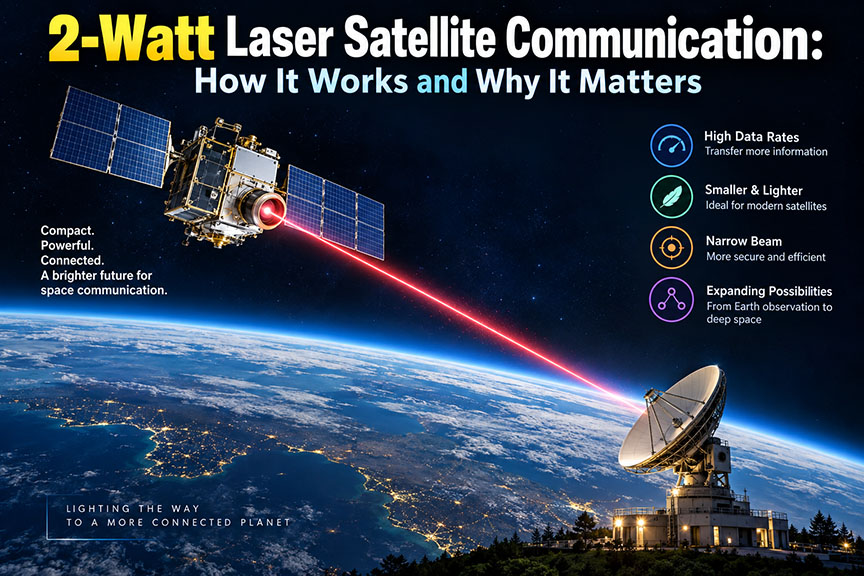
Satellites are producing more data than ever, from high-resolution Earth imagery to scientific measurements and communications traffic. Moving that information efficiently between spacecraft and ground stations is pushing engineers to look beyond conventional radio-frequency links. 2-Watt Laser Satellite Communication represents one approach in which a relatively low-power optical transmitter can send tightly focused, high-bandwidth signals across space.
The “2-watt” figure should not be treated as a universal standard for satellite laser systems. Optical transmitter power varies significantly by mission, range, terminal design, and required data rate. However, real development programs have demonstrated transmitters around this power level, showing why compact optical communications are attracting attention for small satellites and future space networks.
What Is 2-Watt Laser Satellite Communication?
2-Watt Laser Satellite Communication refers to an optical communications system in which a laser transmitter produces roughly two watts of optical output power to carry information.
Instead of broadcasting information over radio frequencies, laser communication generally uses infrared light. Digital information is encoded by modulating the optical signal, and a telescope or optical assembly directs the narrow beam toward another spacecraft or a receiving station.
A useful real-world example comes from the European Space Agency’s Perseus activity, which focused on miniaturized laser-communication transmitters for small satellites. ESA reports that the project developed a high-power variant with 2 W optical output, demonstrated at 3 W, operating at 1550 nanometers and capable of 2 GHz on-off keying non-return-to-zero modulation.
That example illustrates an important point: 2-Watt Laser Satellite Communication is better understood as a practical transmitter-power class or design approach than as one standardized communications system.
How Does 2-Watt Laser Satellite Communication Work?
The basic process is similar to other free-space optical communications systems.
First, spacecraft data are converted into an electrical signal. A modem and associated electronics then encode that information onto the laser beam using an appropriate modulation method. The optical terminal directs the beam toward its destination, where a receiving telescope collects the arriving light and a detector converts the optical signal back into usable data.
The main stages include:
- Preparing and encoding the spacecraft data
- Modulating a near-infrared laser
- Precisely pointing the optical terminal at the receiver
- Transmitting the narrow laser beam across free space
- Collecting the incoming light with a receiving telescope
- Detecting, decoding, and reconstructing the original information
The challenge is not simply generating two watts of laser output. Successful 2-Watt Laser Satellite Communication depends heavily on beam quality, modulation, telescope aperture, pointing accuracy, receiver sensitivity, distance, atmospheric conditions, and the overall link budget.
Why Can a Low-Power Laser Send Large Amounts of Data?
A two-watt transmitter may sound surprisingly modest for communication over hundreds or thousands of kilometers. Optical systems benefit from their extremely narrow beams.
Radio-frequency antennas generally produce beams that spread much more widely than laser beams. A well-designed optical terminal can concentrate transmitted energy into a small angular region, reducing the amount of energy sent where it is not needed.
NASA explains that optical communications use much shorter wavelengths than conventional RF systems, providing access to considerably greater bandwidth. That makes high data rates possible without simply increasing transmitter power.
NASA’s Deep Space Optical Communications experiment offers another useful comparison. Its Psyche spacecraft flight transceiver used a 4-watt near-infrared laser for high-rate downlink experiments over deep-space distances. This does not mean a two-watt system would deliver the same performance, but it demonstrates how relatively modest optical power can support communication across extraordinary distances when the entire link is engineered appropriately.
Advantages of 2-Watt Laser Satellite Communication
The appeal of 2-Watt Laser Satellite Communication is not based on wattage alone. It comes from combining manageable optical power with the characteristics of laser links.
Higher Potential Data Rates
Optical wavelengths offer much greater available bandwidth than traditional RF communications. This can support the transfer of high-resolution imagery, scientific observations, video, and other data-intensive information.
NASA’s TBIRD demonstration, for example, achieved a 200 Gbps space-to-ground optical link. TBIRD is not a two-watt system, so its performance should not be attributed to a 2 W transmitter. Instead, it demonstrates the broader data-rate potential of space-based optical communication.
Smaller and Lighter Hardware
NASA notes that laser communications can reduce size, weight, and power requirements compared with comparable RF systems. These characteristics are particularly valuable for CubeSats and other small spacecraft where every kilogram and watt matters.
A compact 2-Watt Laser Satellite Communication terminal could therefore be attractive when designers must balance communications performance against strict spacecraft resource limits.
Narrower Beams
Laser beams are highly directional. This concentrates transmitted energy toward the intended receiver and reduces unwanted spillover.
The narrow beam also creates one of optical communication’s biggest engineering difficulties: the transmitter and receiver must remain precisely aligned.
The Importance of Pointing and Tracking
Accurate pointing is fundamental to 2-Watt Laser Satellite Communication. A spacecraft cannot simply turn on its laser and expect the ground station to receive the data.
Even tiny pointing errors can cause a narrow beam to miss its receiver over long distances. Optical terminals therefore require acquisition, pointing, and tracking systems capable of establishing and maintaining the link while spacecraft are moving.
This becomes increasingly challenging for satellite-to-ground links, rapidly moving low-Earth-orbit spacecraft, inter-satellite links, and deep-space missions.
Increasing laser power alone cannot solve poor pointing. Efficient optics, stable spacecraft control, accurate tracking, and sensitive receivers are equally important parts of the communications chain.
Atmospheric Conditions Remain a Challenge
Satellite-to-ground 2-Watt Laser Satellite Communication must also deal with Earth’s atmosphere.
Clouds can completely obstruct an optical path. Atmospheric turbulence can distort the incoming wavefront, while aerosols and other conditions may weaken the received signal. Ground networks can address some of these limitations by placing optical stations in geographically separated locations and choosing sites with favorable weather.
Adaptive optics can also compensate for some atmospheric distortion. NASA’s Laser Communications Relay Demonstration ground stations, for example, use adaptive-optics techniques to reduce the effects of atmospheric turbulence.
Space-to-space laser links avoid cloud interference because the signal does not have to pass through the lower atmosphere.
How Does It Compare With Radio Communication?
2-Watt Laser Satellite Communication should not be viewed as a complete replacement for radio.
RF communication has decades of operational heritage and can function in conditions that make an optical link difficult or impossible. Laser systems, meanwhile, offer narrow beams and access to substantially greater bandwidth.
Future spacecraft can therefore benefit from complementary communications technologies. A mission might use optical links for high-volume data transfers while retaining radio systems for command, telemetry, backup communications, or situations where an optical link is unavailable.
The right choice depends on orbit, mission duration, data requirements, spacecraft resources, ground infrastructure, and reliability needs.
Where Could 2-Watt Systems Be Useful?
Compact 2-Watt Laser Satellite Communication technology is particularly relevant to small-spacecraft applications where mass, electrical power, and physical space are limited.
Potential applications include satellite-to-ground downlinks, inter-satellite communications, Earth-observation data transfer, scientific spacecraft, and experimental optical networks.
The ESA Perseus project is especially relevant because it specifically investigated miniaturized transmitters for small-satellite platforms. Such development suggests that engineers are working toward practical optical terminals that fit within increasingly compact spacecraft.
The actual performance of any 2-Watt Laser Satellite Communication system, however, cannot be determined from transmitter wattage alone. Range, optics, coding, modulation, pointing losses, atmospheric losses, receiver design, and other link-budget parameters all influence the final data rate and reliability.
Why This Technology Matters
Spacecraft sensors continue to produce larger datasets, making communications capacity an increasingly important part of mission design. NASA has already demonstrated optical links in low-Earth orbit, geosynchronous orbit, lunar distances, and deep space.
Compact 2-Watt Laser Satellite Communication hardware could contribute to that broader shift by making optical links more accessible to spacecraft that cannot accommodate large communications payloads.
The key achievement is not simply producing a powerful laser. Engineers must combine efficient photonics, accurate pointing, reliable electronics, effective modulation, and sensitive receivers in hardware capable of surviving launch and operating reliably in space.
Frequently Asked Questions
Is a 2-watt laser powerful enough for satellite communication?
Yes, two watts of optical output can be useful in appropriately designed satellite laser communication systems. ESA’s Perseus project demonstrated a transmitter with a specified 2 W optical output. Actual communication range and data rate depend on the complete link design rather than transmitter power alone.
Does laser satellite communication use visible light?
Not necessarily. Many space optical communication systems operate in the near-infrared spectrum rather than producing a beam visible to the human eye. For example, the high-power transmitter described by ESA’s Perseus project operates at 1550 nm.
Is laser communication faster than radio communication?
Laser communication can support much higher data rates because optical frequencies provide access to greater bandwidth and tightly focused beams. However, actual speed depends on the transmitter, receiver, distance, modulation, atmospheric conditions, and other system parameters.
Can clouds interrupt laser satellite communication?
Yes. Dense clouds can block satellite-to-ground optical links. This is one reason optical ground-station diversity, weather monitoring, and hybrid optical/RF architectures are important considerations.
Can 2-Watt Laser Satellite Communication be used between satellites?
Optical technology is well suited to inter-satellite links because the signal travels through space without passing through Earth’s lower atmosphere. Successful operation still requires accurate acquisition, pointing, and tracking between the moving spacecraft.
Conclusion
2-Watt Laser Satellite Communication shows how spacecraft communications are becoming less dependent on high transmitter power alone. By directing modulated optical energy into an extremely narrow beam, engineers can pursue high-capacity links while keeping terminals compact enough for demanding satellite platforms.
Two watts is not a universal specification or a guarantee of a particular data rate. What matters is the complete optical link—from laser efficiency and modulation to telescope design, pointing accuracy, receiver sensitivity, distance, and atmospheric conditions. As those technologies mature, low-power optical terminals could become an increasingly useful part of satellite and space communication networks.
Read Also: Operační System: What It Is and How It Works