
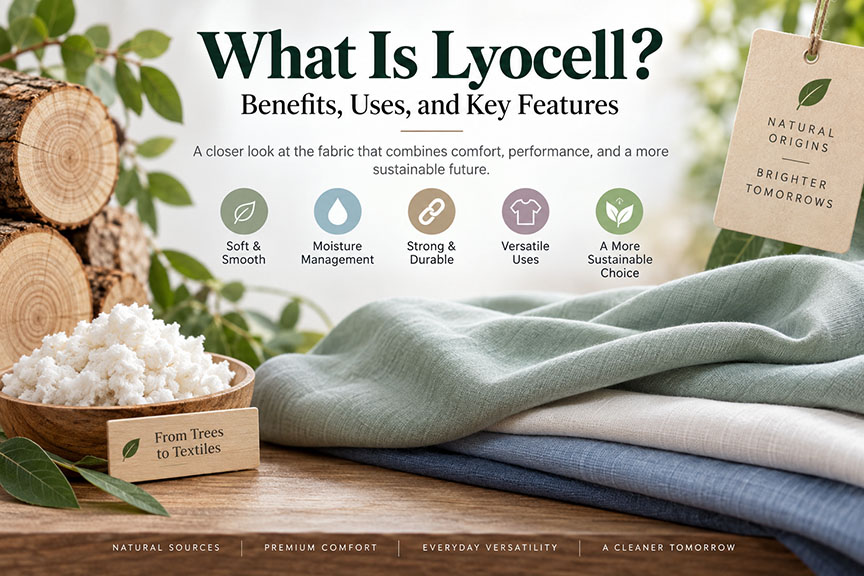
Soft, breathable, and comfortable fabrics are increasingly important to shoppers who want clothing that feels good while also considering how textiles are produced. Lyocell has become a popular choice for clothing, bedding, activewear, and other textile products because of its smooth feel, moisture management, and versatility.
So, What Is Lyocell and why is this material appearing on more clothing labels? Lyocell is a manufactured cellulosic fiber generally made from wood pulp. Although its raw material comes from plants, the cellulose undergoes processing before being regenerated into fibers that can be spun into yarn. Understanding its production and properties can help you decide whether lyocell suits your clothing or home-textile needs.
What Is Lyocell Fabric?
If you are asking What Is Lyocell, the simplest explanation is that it is a regenerated cellulose fiber. Cellulose is a natural substance found in plant cell walls, and wood pulp is commonly used as the source for lyocell production.
Unlike cotton, which provides fibers that can be harvested directly from the plant, lyocell requires purified cellulose to be dissolved and then formed into new fibers. In the United States, the Federal Trade Commission recognizes lyocell as a generic textile-fiber name and a subclass of rayon.
This means lyocell sits between the categories consumers often think of as “natural” and “synthetic.” Its starting material is plant-based, but manufacturing is required to create the usable textile fiber.
It is also worth distinguishing lyocell from TENCEL™. Lyocell is the generic fiber category, while TENCEL™ Lyocell is a branded fiber manufactured by Lenzing.
What Is Lyocell Made From?
Another important part of understanding What Is Lyocell is knowing where the fiber comes from. Lyocell is usually produced from cellulose obtained from wood pulp.
The manufacturing process generally starts by preparing purified cellulose pulp. The cellulose is dissolved in a solvent, creating a solution that can be pushed through tiny openings called spinnerets. The cellulose is then regenerated into fibers, washed, finished, and eventually spun into yarn.
The basic stages include:
- Preparing cellulose-rich pulp
- Dissolving the cellulose
- Filtering the resulting solution
- Forming fibers through spinnerets
- Regenerating the cellulose into solid fibers
- Washing and finishing the fibers
- Spinning the finished fibers into yarn
A significant feature of modern lyocell manufacturing is the potential for closed-loop solvent recovery. Lenzing, for example, states that its TENCEL™ Lyocell production process recovers more than 99.8% of the solvent used. This figure applies specifically to Lenzing’s manufacturing system and should not automatically be applied to every lyocell producer.
What Is Lyocell Known For?
Understanding What Is Lyocell also requires looking at how the fiber behaves once it becomes fabric. The precise characteristics of a finished textile depend on its weave or knit, weight, finishing treatments, and whether other fibers are blended with it.
Soft and Smooth Texture
Lyocell can create fabrics with a soft, smooth surface. This quality makes it suitable for products worn directly against the skin, including T-shirts, underwear, dresses, sleepwear, and shirts.
However, not every lyocell textile feels identical. A lightweight woven shirt may feel very different from a thick pair of lyocell-blend jeans.
Moisture Management
Lyocell fibers can absorb moisture, which may help move moisture away from the skin and contribute to comfort. This characteristic makes the material useful for warm-weather garments and products designed for extended wear.
Actual comfort still depends on the construction and weight of the fabric as well as any additional fibers in a blend.
Strength
Lyocell is also valued for its useful strength. Manufacturers can incorporate it into lightweight clothing, denim, bedding, and various blended textiles.
Fiber strength alone does not determine how long a garment will last. Stitching, fabric construction, thickness, finishing, washing habits, and overall manufacturing quality also matter.
Attractive Drape
Many lyocell fabrics have a flowing appearance and pleasant drape. This makes the material particularly useful for dresses, skirts, loose trousers, blouses, and relaxed shirts.
Benefits of Lyocell Fabric
People researching What Is Lyocell are often interested in whether the material offers practical benefits compared with familiar fabrics.
One of its major advantages is comfort. Its smooth surface and moisture absorption can make well-constructed lyocell garments comfortable against the skin.
Versatility is another benefit. Lyocell can be used by itself or blended with cotton, wool, and synthetic fibers to create fabrics with different textures and performance characteristics.
Its ability to produce soft, flowing fabrics is also useful in fashion. Depending on construction and finishing, manufacturers can create everything from lightweight dresses to structured denim blends.
Many lyocell products are washable as well. However, the care requirements of the finished garment always matter more than general advice about the fiber.
Is Lyocell Sustainable?
Sustainability is one reason searches for What Is Lyocell have become relevant to environmentally conscious consumers. Because lyocell is derived from cellulose, its raw material can come from renewable plant sources. Certain closed-loop manufacturing processes can also recover and reuse a very high proportion of the processing solvent.
However, calling every lyocell product “sustainable” would oversimplify the issue.
A textile’s overall environmental impact can be influenced by:
- The source of the wood pulp
- Forest-management practices
- Energy used during production
- Solvent recovery and chemical management
- Dyeing and finishing processes
- Transportation
- Product durability
- Fiber blends
- End-of-life treatment
Consumers interested in sustainability should therefore look beyond the word “lyocell” on the label. Information about responsible wood sourcing, credible certifications, production methods, and manufacturer transparency provides more context.
Common Uses of Lyocell
Learning What Is Lyocell is especially useful when shopping because the fiber now appears across many textile categories.
In clothing, lyocell can be found in:
- Shirts and blouses
- Dresses and skirts
- T-shirts
- Trousers
- Underwear
- Sleepwear
- Denim blends
- Lightweight warm-weather garments
Lyocell is also used in home textiles, particularly bedding and similar products where softness and moisture management are desirable.
Blended fabrics are common. A garment might contain lyocell and cotton for a particular feel or combine lyocell with other fibers to modify stretch, durability, structure, or performance.
Checking the percentages on the fiber-content label is therefore important. A product containing a small amount of lyocell may behave quite differently from one made primarily or entirely from it.
Lyocell vs. Cotton
A comparison with cotton can make What Is Lyocell easier to understand.
Both materials have plant-based cellulose at their foundation, but their production methods differ substantially. Cotton fibers grow naturally around cotton seeds and are harvested, cleaned, and processed into yarn. Lyocell is manufactured by extracting cellulose—typically from wood pulp—dissolving it, and regenerating it into fibers.
Both can produce soft and comfortable textiles. Lyocell is particularly associated with smoothness, moisture uptake, and fluid drape, while cotton is available in an enormous variety of fabric constructions and textures.
Neither is automatically the better choice. Fabric quality, garment construction, intended use, care requirements, sourcing, and personal preferences all matter.
Lyocell vs. Viscose
People researching What Is Lyocell may also encounter viscose because both belong to the regenerated cellulose family.
Their key difference lies in the production method. Traditional viscose manufacturing chemically modifies cellulose before dissolving it. Lyocell production uses a direct-solvent process to dissolve cellulose without the same derivatization step.
For shoppers, however, manufacturing method is only part of the decision. A high-quality viscose garment can perform differently from a poorly constructed lyocell garment and vice versa. The fiber label should be considered alongside construction, finishing, fit, and care requirements.
How to Care for Lyocell Clothing
Knowing What Is Lyocell can help with fabric selection, but proper care is equally important for maintaining the finished product.
Always read the care label before washing. Different dyes, finishes, fabric constructions, and fiber blends can result in different cleaning requirements even when two garments both contain lyocell.
Where machine washing is permitted:
- Use the recommended water temperature.
- Choose an appropriate detergent.
- Avoid excessive heat unless the label allows it.
- Treat stains carefully.
- Check instructions before tumble drying.
- Follow recommended ironing temperatures.
- Pay attention to the other fibers in blended fabrics.
Avoid assuming that every lyocell garment can be washed in exactly the same way. The manufacturer’s instructions are designed for the complete garment rather than just one fiber within it.
Frequently Asked Questions
What Is Lyocell, and is it natural or synthetic?
The answer to What Is Lyocell does not fit perfectly into the traditional natural-versus-synthetic distinction. Lyocell begins with naturally occurring cellulose, usually sourced from wood, but that cellulose is dissolved and regenerated through an industrial manufacturing process. It is generally classified as a manufactured or regenerated cellulosic fiber.
Is lyocell the same as TENCEL™?
No. Lyocell is the generic name of a type of fiber, whereas TENCEL™ is a trademark owned by Lenzing. TENCEL™ Lyocell is therefore a branded form of lyocell rather than a different generic fiber category.
Is lyocell suitable for hot weather?
It can be. Lyocell’s moisture absorption and potential for lightweight fabric construction can make it comfortable in warmer conditions. However, thickness, weave, knit, fit, and blended fibers also affect how a garment performs in hot weather.
Does lyocell shrink after washing?
Shrinkage can depend on the fabric’s construction, finishing, washing temperature, and drying method. Following the manufacturer’s care label is the safest way to reduce the risk of unwanted shrinkage or damage.
Is lyocell better than cotton?
There is no universal winner. Lyocell may appeal to people looking for smoothness, drape, and moisture management, while cotton offers extensive variety, familiarity, and versatility. The better option depends on the particular garment and how it will be used.
Is lyocell biodegradable?
Lyocell itself is cellulose-based and can biodegrade under suitable conditions. A finished garment, however, may contain synthetic fibers, dyes, coatings, elastane, or other components that affect its overall biodegradability. Product-specific information is more reliable than assuming every lyocell-containing textile will behave the same way.
Conclusion
For anyone still considering What Is Lyocell, the key point is that it combines a plant-derived cellulose source with a manufactured fiber-production process. The resulting material can offer softness, moisture absorption, useful strength, and attractive drape, making it suitable for clothing, bedding, denim blends, and many other textiles.
Lyocell can also have environmental advantages when wood is responsibly sourced and manufacturing uses efficient closed-loop processes. Those benefits should still be evaluated at the product and manufacturer level rather than assumed from the fiber name alone.
Checking fiber percentages, construction quality, sourcing information, and care instructions gives shoppers a clearer picture of what they are buying—and whether a particular lyocell product fits their needs.
Read Also: iPhone 17 Pro Max Case Nearby: A Local Buying Guide