
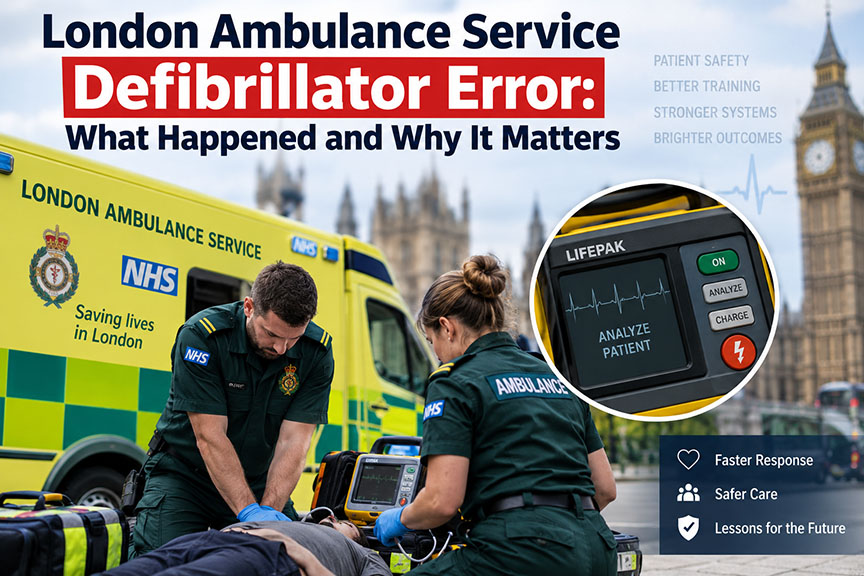
A medical emergency can turn on decisions made within seconds, particularly when a patient’s heart has stopped. That reality is central to the London Ambulance Service Defibrillator Error involving Meg Fozzard, who suffered a cardiac arrest at her south London home in 2019. The case received renewed public attention in 2026 after details of an undisclosed NHS settlement and the emergency response were reported.
The incident raises serious questions about defibrillator operation, recognition of cardiac arrest, clinical training, and patient safety. It also shows why emergency equipment is only as effective as the systems, procedures, and people responsible for using it.
What Happened in the London Ambulance Service Defibrillator Error?
Meg Fozzard was 26 when she suffered a cardiac arrest at her home in Walworth, south London, in 2019. Before collapsing, she had reportedly experienced difficulty breathing, became extremely pale, and had a seizure. Her cardiac arrest was later linked to an underlying heart condition.
Her partner, Xander Font Freide, called 999 and was instructed by the emergency call handler to perform CPR.
According to reporting about the case, London Ambulance Service paramedics initially had difficulty locating the flat. Once they reached Fozzard, further problems occurred during her emergency treatment.
The London Ambulance Service Defibrillator Error centred on the use of a LIFEPAK device. Reports said the automatic analysis mode was not initially activated. An incorrect control was then selected, adding to the delay before the device could assess her heart rhythm and a shock could be delivered.
The reported total delay before defibrillation was approximately eight minutes.
Why the Defibrillator Delay Was So Serious
Cardiac arrest means the heart has stopped effectively pumping blood around the body. Without circulation, the brain and other vital organs are deprived of oxygen.
CPR helps maintain some blood flow while emergency treatment is being provided. A defibrillator, meanwhile, analyses the heart rhythm and can deliver an electrical shock when an appropriate shockable rhythm is detected.
That makes delays particularly significant.
In the London Ambulance Service Defibrillator Error case, Fozzard survived but sustained a serious brain injury associated with oxygen deprivation. She has since lived with long-term disabilities and has required extensive rehabilitation and support.
Her case illustrates an essential principle of cardiac-arrest care: CPR should begin quickly, and appropriate defibrillation should take place as soon as possible when the patient’s rhythm requires it.
What Did London Ambulance Service Say?
London Ambulance Service publicly apologised for the standard of care Fozzard received.
Its Chief Medical Officer, Dr Fenella Wrigley, said in a statement reported in 2026 that the care provided that day in 2019 did not meet the standard expected by the Service.
LAS also said it carried out a thorough review in the weeks following the 999 call. According to the Service, lessons identified through that review were implemented and working practices were changed.
The response is important because the London Ambulance Service Defibrillator Error was not treated simply as an isolated technical malfunction. The available accounts point to a combination of human factors, device operation and clinical decision-making during a highly time-sensitive emergency.
What Changed After the Incident?
The concerns surrounding this case reached beyond the individual emergency response.
A Department of Health and Social Care response published in connection with a prevention-of-future-deaths process discussed the functionality of defibrillator/monitor equipment used by London Ambulance Service. It noted measures taken by LAS that included updated cardiac-arrest guidance, human-factors training and focused training for solo first responders.
The response also discussed the possibility of equipment that could reduce the need for users to actively select particular operating modes.
This is one reason the London Ambulance Service Defibrillator Error matters from a broader patient-safety perspective. Medical equipment design, staff training, clinical procedures and human behaviour under pressure can interact. Improving safety therefore involves more than addressing a single mistake.
Why Defibrillator Design and Training Matter
Modern defibrillators used by ambulance clinicians can be more sophisticated than the automated external defibrillators found in shopping centres, stations and other public locations. Professional devices may combine cardiac monitoring and defibrillation functions and offer different operating modes.
That flexibility can be valuable for trained clinicians, but emergency systems must also account for human factors.
Clear controls, effective training, regular practice and well-designed protocols can reduce the likelihood that confusion causes a critical delay. The London Ambulance Service Defibrillator Error demonstrates why organisations need to review not only whether equipment works correctly but also how easily clinicians can operate it during stressful emergencies.
Training should also reinforce rapid recognition of cardiac arrest and the appropriate sequence of CPR, rhythm assessment and defibrillation.
What Happened to Meg Fozzard?
The consequences for Fozzard extended far beyond the original emergency.
Following her brain injury, she faced significant difficulties with mobility, speech, fatigue and other aspects of daily life. Her rehabilitation has included specialist therapies, and she has publicly discussed rebuilding parts of her life and independence.
In 2026, it was reported that she had received an undisclosed settlement connected with her case. The exact financial value was not made public, so estimates circulating without reliable evidence should not be presented as fact.
The settlement provides support for her continuing rehabilitation and long-term needs.
Her experience gives the London Ambulance Service Defibrillator Error a human dimension that can be lost when medical incidents are discussed only in terms of equipment and procedures. Patient-safety failures can have consequences lasting for decades.
What the Public Should Know About Defibrillators
This case should not discourage people from using a public-access defibrillator during a suspected cardiac arrest.
Public automated external defibrillators are specifically designed to guide users. London Ambulance Service advises that these devices analyse the person’s heart rhythm and only recommend or deliver a shock when appropriate.
If someone is unconscious and not breathing normally, the priority is to call 999 and follow the call handler’s instructions. CPR should be started, and someone should retrieve a nearby defibrillator if one is available.
Public AEDs provide audible and visual instructions, making them usable even by people without specialist medical training.
The circumstances behind the London Ambulance Service Defibrillator Error involved professional emergency care and specialist equipment. They should not be interpreted as evidence that members of the public should hesitate to use an AED when instructed during a cardiac-arrest emergency.
Frequently Asked Questions
What was the London Ambulance Service defibrillator incident?
The incident involved Meg Fozzard, who suffered a cardiac arrest at her south London home in 2019. Problems during the emergency response reportedly contributed to a delay of around eight minutes before defibrillation was delivered.
Did London Ambulance Service acknowledge problems with her care?
Yes. London Ambulance Service publicly apologised and said the care provided to Fozzard did not meet its expected standard. The Service also said it reviewed the incident and implemented lessons identified afterward.
Was the defibrillator itself broken?
Publicly available accounts focus primarily on the operation and selected mode of the specialist device rather than establishing that the equipment had suffered a mechanical breakdown. Describing the London Ambulance Service Defibrillator Error simply as a defective machine would therefore be misleading.
Why is rapid defibrillation important during cardiac arrest?
Cardiac arrest stops effective blood circulation. CPR can temporarily help maintain blood flow, while defibrillation can treat certain abnormal heart rhythms. For shockable rhythms, rapid defibrillation is a crucial part of resuscitation.
Are public defibrillators safe for untrained people to use?
Yes. Public automated external defibrillators are designed to analyse heart rhythm and guide the person providing assistance. Users should follow the device prompts and instructions from the 999 call handler.
Did Meg Fozzard receive compensation?
Reports published in 2026 confirmed an undisclosed settlement following her case. The amount has not been publicly disclosed, so any unsupported figure should be treated cautiously.
Conclusion
The London Ambulance Service Defibrillator Error is significant because it demonstrates how recognition of cardiac arrest, equipment operation, human factors and rapid decision-making can directly affect patient outcomes.
London Ambulance Service acknowledged that Fozzard’s care fell below its expected standard and said lessons from its review were implemented. For emergency medical services more broadly, the case reinforces a fundamental patient-safety principle: life-saving equipment must be supported by clear procedures, effective training and systems designed to minimise avoidable delays when every second matters.
Read Also: Alexee Trevizo 2025: Case Updates, Court Proceedings and Key