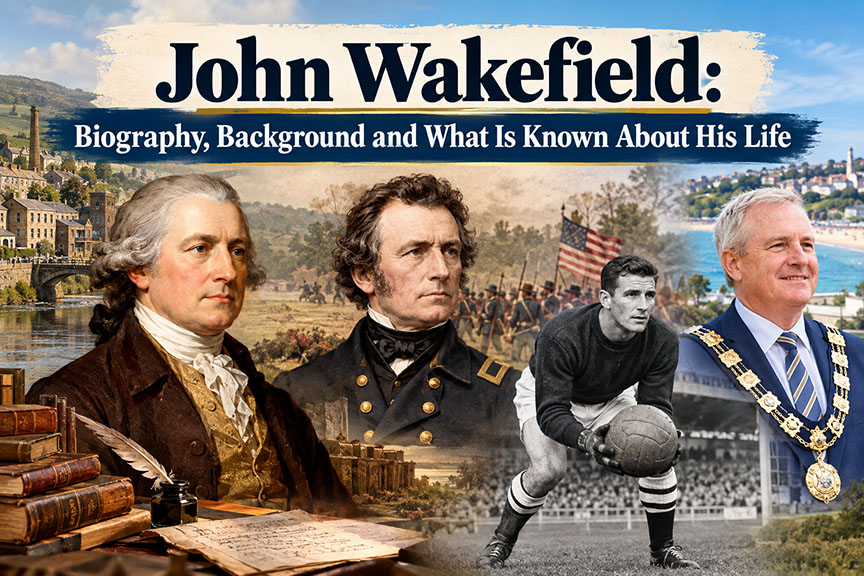
Searching for John Wakefield can be surprisingly complicated. The name does not identify one universally recognized public figure; instead, historical and modern records connect it with several different people in banking, politics, military history, sport, entertainment, and local government.
One of the best-documented figures with the exact name is an 18th-century English merchant and banker based in Kendal. Another prominent historical figure was John Allen Wakefield, an American soldier, physician, lawyer, politician, and writer associated with the Black Hawk War. Other records identify people with the same name in football, acting, and Australian local government.
This biography explains what reliable sources establish about these individuals and, importantly, how to avoid combining information belonging to different people.
Who Was John Wakefield?
There is no single answer to “Who was John Wakefield?” without additional context.
Historical references identify John Wakefield (1738–1811) as an English Quaker merchant, entrepreneur, financier, and banker associated with Kendal in what was then Westmorland. His commercial interests extended beyond banking into industries including textiles, brewing, shipping, and gunpowder.
A separate person, John Allen Wakefield (1797–1873), became known in the United States through military service, politics, medicine, law, and his account of the Black Hawk War.
The distinction matters. Treating these records as the biography of one person would create a misleading profile.
John Wakefield the Kendal Banker
Among the strongest historical matches for the exact name is John Wakefield, born in 1738 and associated with Kendal.
Records describe him as the son of Roger Wakefield and Mary Wilson. He began his working life in the family dyeing business and eventually developed much wider commercial interests. His activities came to include cotton manufacturing, brewing, shipping, finance, and gunpowder production.
His importance to Kendal’s commercial history is particularly connected with banking. In 1788, he established a bank in the town. Historical accounts of Kendal later record the combination of the Wakefield banking business with another local banking operation in 1840.
Business Interests Beyond Banking
John Wakefield was not simply a banker. Records connect him with the Gatebeck gunpowder works and later a mill at Sedgwick. He also had interests in cotton production, brewing, transportation and overseas trade.
His involvement in gunpowder manufacturing also created tension with his Quaker background. Historical accounts state that the Kendal Monthly Meeting censured him in 1806 over his continuing involvement in that trade.
These details place him within the broader commercial transformation occurring in northern England during the late 18th and early 19th centuries.
Family Background of John Wakefield
Genealogical references identify the Kendal banker as the son of Roger Wakefield and Mary Wilson. He married Margaret Hodgson in 1760. Records place his birth on December 18, 1738, and his death on May 26, 1811.
The Wakefield family continued to be associated with banking after his death. His son, also named John, lived from 1761 to 1829, demonstrating another reason researchers must pay close attention to dates and generations when examining the family.
Later generations remained involved in the Kendal banking world. This repetition of the same first and last name within a family can easily lead to inaccurate online biographies when records are combined without proper verification.
John Allen Wakefield: A Different Historical Figure
Another frequently encountered result is John Allen Wakefield. He should not be confused with the English banker.
John Allen Wakefield was born in South Carolina in 1797 and later lived in several parts of the expanding United States. Biographical material describes him as a soldier, physician, lawyer, politician, and historian. His family moved through Tennessee and Kentucky before settling in Illinois Territory.
He served in the Illinois militia during the War of 1812 era and later participated in the Black Hawk War of 1832. He subsequently wrote an account of that conflict, published in 1834 and later reprinted as Wakefield’s History of the Black Hawk War.
His public life also included service in state politics. Records identify legislative service in Illinois and later Kansas. He eventually lived in Lawrence, Kansas, where he died in 1873.
Other People Named John Wakefield
The identity problem does not end with these two historical figures.
A John Wakefield born in 1934 appears in records connected with Britain’s football squad for the 1960 Summer Olympics. Tournament squad records identify him as a goalkeeper associated with Corinthian-Casuals.
Entertainment records also contain the name. IMDb, for example, lists an American actor named John Wakefield, born in Lincoln, Nebraska, in 1963, with credits including Man Wanted and Echoes of the Rainbow. A separate British performer with the same name lived from 1936 to 2019.
Australian municipal records provide yet another example. Waverley Council documentation from 2017 identifies Councillor John Wakefield as mayor and representative of Bondi Ward. Council histories record separate mayoral terms beginning in 2011 and 2017.
These examples show why a profession, location, middle name, or approximate date is essential when researching someone with this name.
How to Identify the Correct John Wakefield
Readers researching John Wakefield should avoid relying on the name alone. A more reliable approach is to compare several identifying details:
- Full name, including middle names or initials
- Birth and death dates
- Country and city
- Occupation or profession
- Employer or organization
- Family relationships
- Dates of documented activities
Primary records, government documents, established historical collections, institutional archives, and reputable reference works should generally receive greater weight than unsourced biography websites.
This approach is particularly important when researching genealogy. Two people sharing a name may have lived in entirely different countries or centuries, and combining their records can create an inaccurate family history.
Frequently Asked Questions
Who is John Wakefield?
The name refers to multiple people. One well-documented John Wakefield was an English Quaker merchant and banker who lived from 1738 to 1811. Other people with the name have worked in sport, acting and public life. John Allen Wakefield was a separate 19th-century American historical figure.
What was John Wakefield known for?
The 1738–1811 English John Wakefield is known primarily for his business activities in Kendal, including banking, textiles, brewing and gunpowder manufacturing. He established a bank in Kendal in 1788.
Is John Wakefield the same person as John Allen Wakefield?
No. John Allen Wakefield was an American born in 1797 who became associated with military service, law, medicine, politics and historical writing. The Kendal businessman John Wakefield was an English merchant and banker born in 1738.
Was there a John Wakefield associated with the Olympics?
Yes. Records for the 1960 Olympic football tournament list John Wakefield among the Great Britain squad. Squad information identifies him as a goalkeeper associated with Corinthian-Casuals.
Was John Wakefield a mayor in Australia?
Waverley Council records identify Councillor John Wakefield as mayor in New South Wales. Official council minutes from October 2017 list him as mayor and a councillor representing Bondi Ward.
Conclusion
Researching John Wakefield illustrates an important challenge in biographical research: a familiar name can belong to several unrelated people. The strongest historical records include an English banker and entrepreneur born in 1738 and the separate American figure John Allen Wakefield, born in 1797. The name also appears in records relating to football, acting, and Australian local government.
For readers trying to identify a particular John Wakefield, dates, occupations, locations, and middle names provide essential context. Reliable sources should be compared before personal history, career details, or family relationships are attributed to any one individual. Keeping these identities separate produces a far more accurate picture than attempting to combine scattered search results into a single biography.
Read Also: Christine Gacy: Biography, Family Background & Life